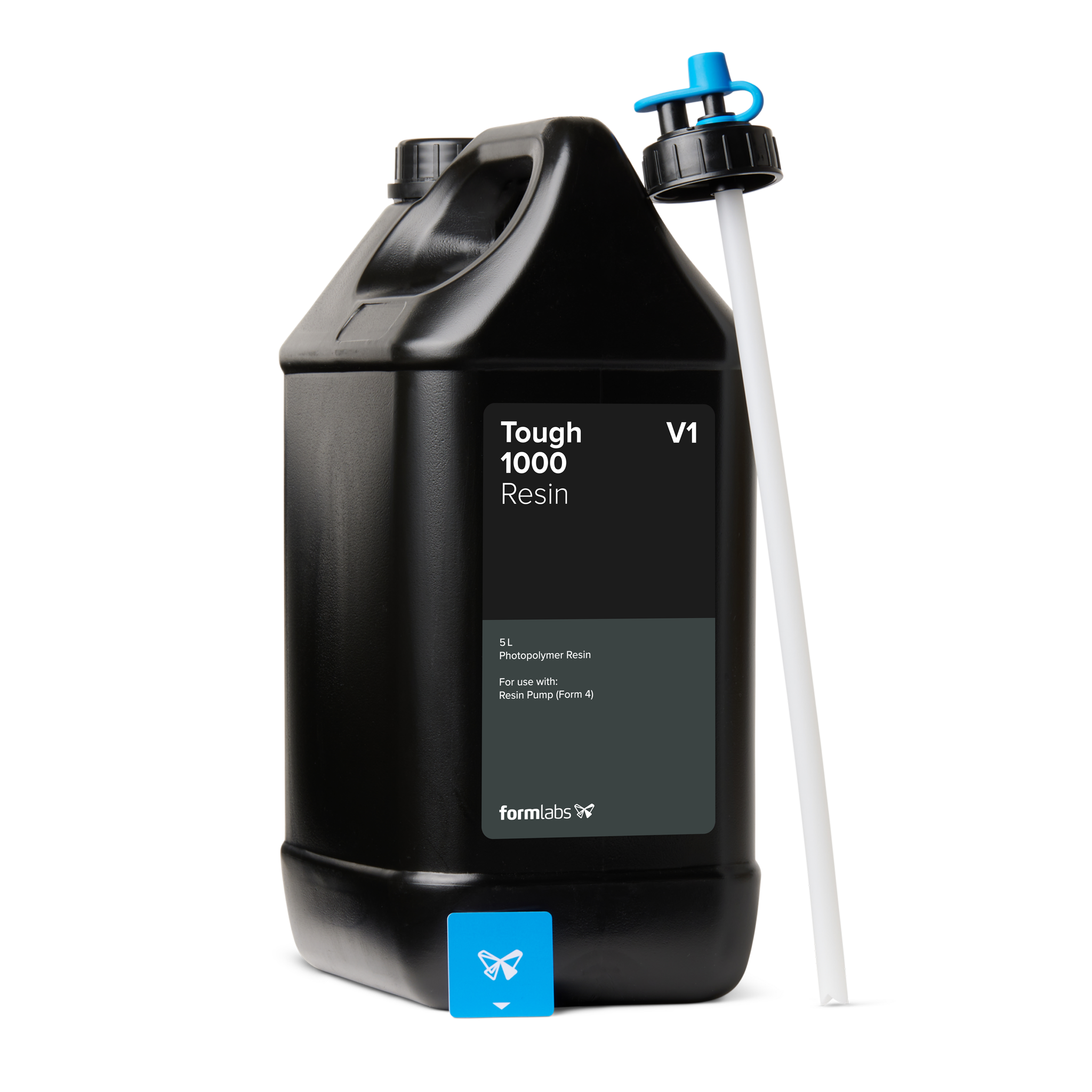
The HDPE-Like Solution for High-Impact & Dynamic Parts
Tough 1000 Resin V1 is the most ductile material in the Formlabs Tough family. It is optimized for parts that need to bend, compress, and deform repeatedly without cracking. With its matte dark grey finish and low-friction surface, it is the ideal choice for functional assemblies that require the forgiveness of a flexible thermoplastic combined with the precision of the Form 4 LFD engine.
Key Features
-
Exceptional Ductility: Boasting a 180% elongation at break, this resin allows for extreme deformation, making it perfect for squeezable prototypes and snap-fits.
-
High-Cycle Fatigue Resistance: Engineered for longevity, it features a Ross Flex Fatigue rating of over 100,000 cycles, ensuring that living hinges and compliant mechanisms maintain their integrity under repeated stress.
-
Impact-Ready: With a Gardner impact strength of 128 in-lb, parts printed in Tough 1000 can survive drops and high-impact environments on the factory floor that would shatter standard resins.
-
Low-Friction Surface: The material's high lubricity is comparable to Delrin (POM), making it excellent for sliding assemblies, ball joints, and gears where minimal surface resistance is required.
Ideal Applications
-
Industrial Jigs & Fixtures: Impact-resistant tools that withstand daily abuse in manufacturing environments.
-
Compliant Mechanisms: Living hinges, latches, and springs that require high-cycle fatigue resistance.
-
Low-Friction Assemblies: Gears, bushings, and ball joints requiring smooth, non-degrading surfaces.
-
HDPE Prototyping: Validating designs for parts eventually intended for high-density polyethylene injection molding.
FAQ
How Does Tough 1000 Compare to Tough 1500 and 2000?
Think of them on a spectrum of stiffness: Tough 2000 is the stiffest (ABS-like), Tough 1500 is the middle ground (Polypropylene-like), and Tough 1000 is the most flexible and impact-resistant.
Does it Require Special Post-Processing?
For optimal properties, parts should be washed in 99% IPA and post-cured. Formlabs recommends a post-cure of 60 minutes at 70°C in the Form Cure to reach full mechanical strength and fatigue resistance.