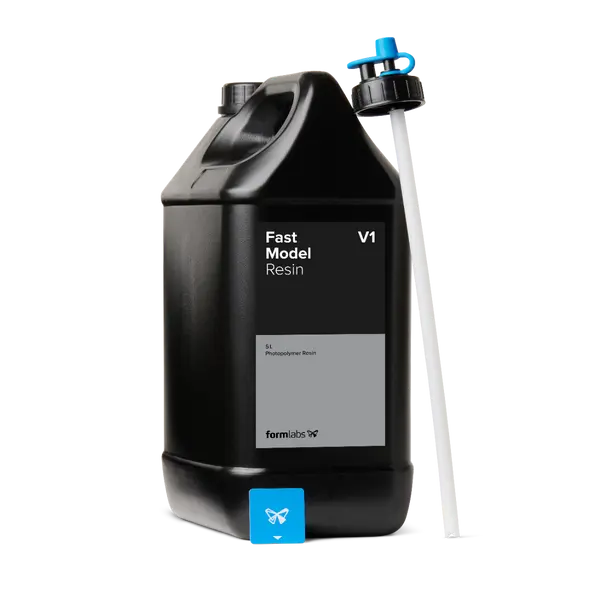
Record-Breaking Speed for Rapid Iteration & Dental Labs
Fast Model Resin leverages the full power of the Form 4 to achieve vertical print speeds of up to 100 mm/hour. This means most dental models or small prototypes can be completed in under 10 minutes, and full-build-height parts can be finished in approximately 90 minutes. Despite its incredible speed, it maintains the high dimensional accuracy and crisp detail required for professional engineering and dental workflows.
Key Features
-
Exceptional Accuracy: Specifically tuned to maintain tight tolerances, ensuring that even at high speeds, orthodontic models and mechanical prototypes fit their counterparts perfectly.
-
Balanced Mechanical Profile: Offers a versatile combination of stiffness and strength, making it suitable for both aesthetic models and light functional testing.
-
High-Contrast Mint Finish: The light green, matte surface provides excellent visual clarity for inspecting fine features, dental margins, or embossed text.
-
Streamlined Post-Processing: Formulated for a quick wash and a rapid 5-minute cure, ensuring the entire "CAD-to-Part" workflow is as fast as the print itself.
Ideal Applications
-
Rapid Design Iteration: Printing multiple versions of a part in a single afternoon to verify ergonomics or "form and fit".
-
Orthodontic Models: High-volume production of models for clear aligner or retainer thermoforming.
-
Educational Demonstrations: Completing a print within a single class period or lab session.
-
Initial Prototyping: Checking the scale and volume of large assemblies before committing to longer-running engineering resins.
FAQ
How Does the Speed Compare to Draft Resin?
Fast Model Resin is the successor to Draft Resin for the Form 4 generation. It is faster, more accurate, and offers better mechanical properties, making it a superior choice for both dental and engineering users.
Can I Use This on a Form 3?
No. Fast Model Resin is chemically optimized strictly for the Form 4 series.
Is it Suitable for Final End-Use Parts?
While Fast Model is quite strong (50 MPa), it is optimized for speed and "form/fit" testing. For parts requiring long-term durability or specific environmental resistance, we recommend moving to the Tough or Flame Retardant libraries once the design is finalized.